Project Overview
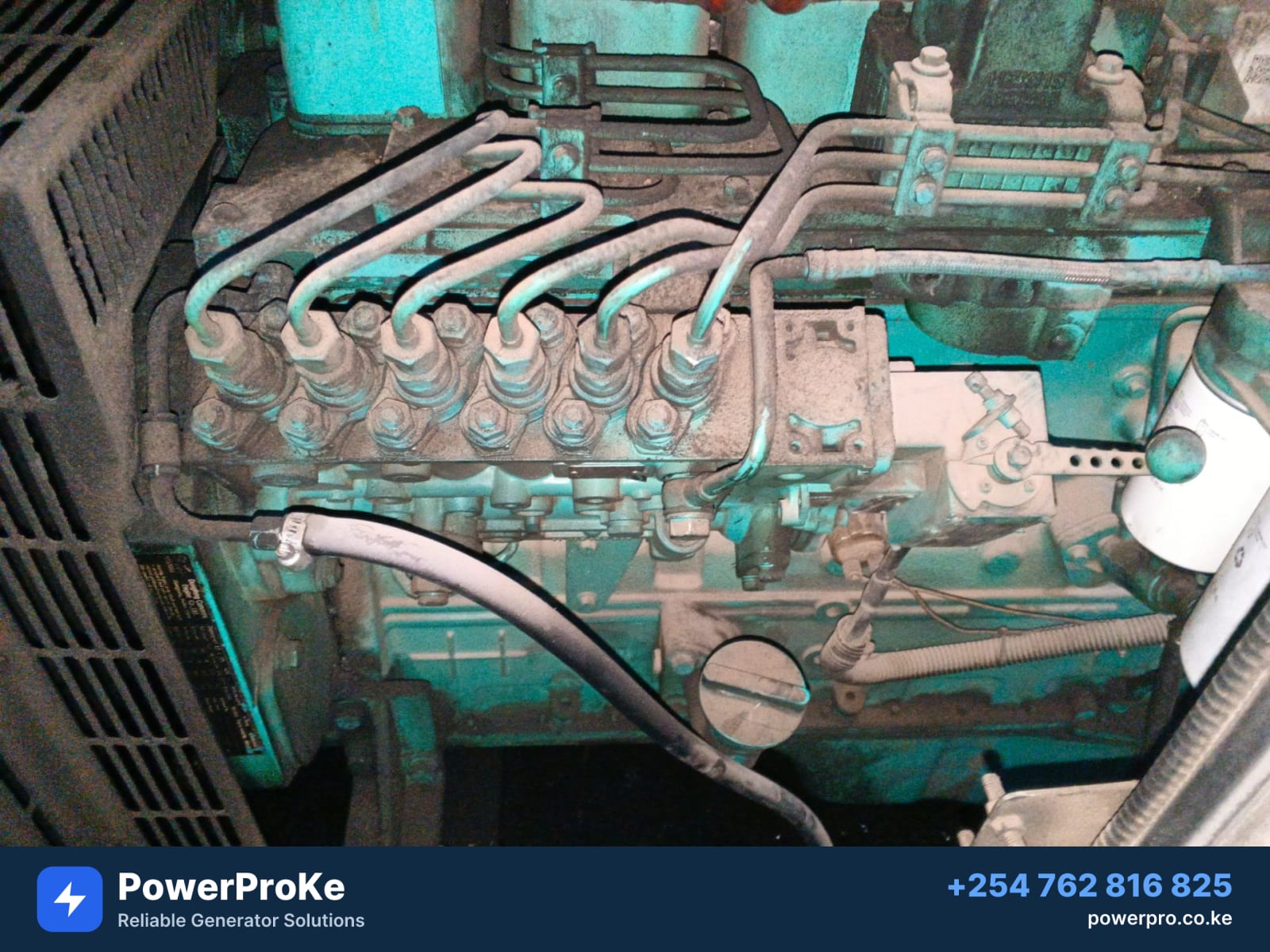
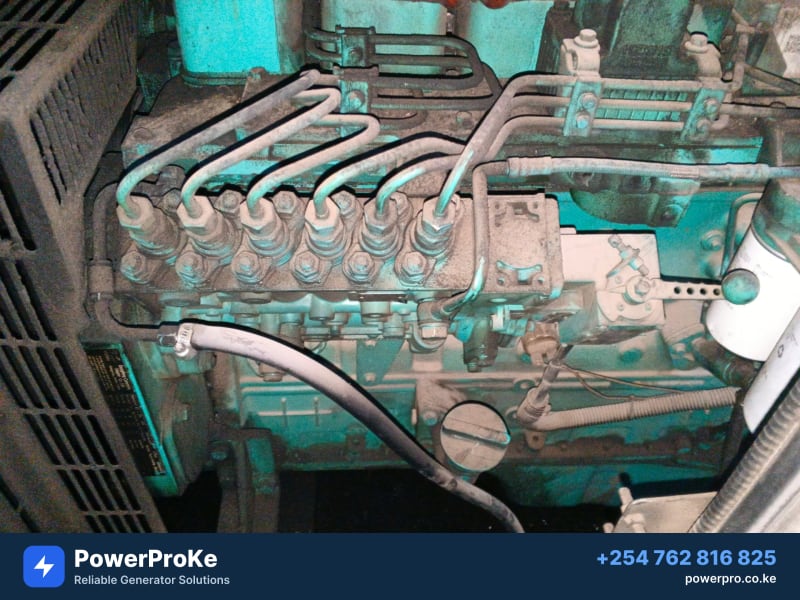
A commercial client in Syokimau contacted PowerProKe after recognising that their standby generator had not received any professional attention for two years. For a facility that depends on a single 100 kVA Cummins 6BTAA5.9-G12 to hold critical loads during mains outages, that gap represents a serious reliability risk. Technician Daniel was sent to carry out a thorough generator site assessment across all major systems — engine, electrical, fuel, cooling, alternator, controls and ATS — to establish the true condition of the machine and define what needed to happen next.
The goal was not to carry out a full service on the day but to give the client an accurate picture of where the generator stood, what was urgent, and what a structured maintenance programme should address. That kind of honest assessment is often the most valuable first step for a facility that has fallen behind on maintenance.
Initial Symptoms
- Generator had not been serviced for approximately two years
- Exhaust system showing signs of a fume leak at a joint or seam
- No scheduled filter changes or lubrication system maintenance had been carried out during that period
What Our Engineer Found
Rated Fair solely because the generator had gone approximately two years without any maintenance. Oil and filters were overdue for replacement, putting the engine bearings and moving parts at risk of accelerated wear and potential seizure.
A leak was identified at an edge or joint on the exhaust, allowing combustion fumes to escape. This is both a safety concern — fume accumulation in an enclosed plantroom — and an indicator of thermal stress or corrosion on the exhaust assembly.
No issues found.
No issues found.
No issues found.
No issues found.
No issues found.
No issues found.
No issues found.
No issues found.
No issues found.
Root Cause
The root cause of the generator's current risk profile is straightforward: a two-year gap in scheduled maintenance. On a diesel engine, lubricating oil degrades over time regardless of running hours — it oxidises, accumulates combustion by-products and loses its viscosity characteristics. Filters become restricted. Without regular inspection, an exhaust joint that develops a small crack or begins to corrode goes unnoticed until fumes are already escaping. None of these failures are dramatic on their own, but together they represent the kind of cumulative neglect that leads to expensive engine damage or an unexpected breakdown at the worst possible moment.
What We Did
Daniel carried out a comprehensive assessment of all generator systems, working through the starting, fuel, cooling, lubrication, electrical, charging, alternator, control, ATS and mechanical systems methodically. Operational readings were taken to confirm the machine was running: output voltage, frequency, engine speed, coolant temperature and battery voltage were all recorded. The exhaust was inspected and the fume leak at the joint was identified and documented. A prioritised action plan was drawn up, with filter replacements scheduled within 30 days and exhaust repair listed as the immediate next step. Clients seeking a structured programme going forward can consider a generator maintenance contract to ensure intervals are never missed again.
Results
At the time of the assessment the generator was running and producing 230 V output at 51 Hz, with engine speed at 1,501 rpm and coolant temperature at 51 °C. The machine was operational, which confirms that the two-year maintenance gap had not yet caused a breakdown — but the lubrication system rating of Fair and the exhaust leak make clear that the window for preventive action is now, not later.
Recommendations
- Repair the exhaust system: weld the leaking edge or joint to stop fume escape — treat this as an immediate safety item, not a deferred task
- Replace the oil filter (P558615), fuel filter (FF5052), fuel water separator (1280) and air filter (K19950C1) within 30 days
- Put in place a scheduled maintenance programme so the generator is serviced at regular intervals going forward — a two-year gap must not be repeated
- Carry out a full oil and lubrication service as part of the upcoming filter change visit
Lessons for Facility Managers
This assessment in Syokimau is a clear example of what happens when a standby generator is left to run unsupervised without a maintenance schedule. The machine kept starting, so there was no obvious alarm — but inside the engine, oil was degrading and the exhaust was quietly developing a leak. By the time a generator shows obvious symptoms of neglect, the repair bill is usually far larger than the cost of the missed services.
Facility managers running Cummins generators on standby duty should treat the manufacturer's service intervals as a minimum, not a target to defer. A generator that starts every time it is tested is not necessarily a healthy generator — only a proper inspection by a qualified technician will reveal what is building up underneath the surface. The generator maintenance checklist is a useful reference for understanding what each service interval should cover.
Photos from the Site
Case Study FAQ
How long can a diesel generator go without a service?
Most diesel generator manufacturers recommend servicing intervals based on running hours — commonly every 250 to 500 hours — or at least once a year, whichever comes first. Even a generator on light standby duty should be inspected and have its fluids and filters checked annually. Going two years without any maintenance, as in this case, puts the lubrication system and other consumable components at serious risk.
What happens if generator engine oil is not changed for two years?
Engine oil degrades over time through oxidation, moisture absorption and the accumulation of combustion by-products. After two years, it loses much of its lubricating ability. Running an engine on degraded oil accelerates wear on bearings, cylinders and other moving parts, and can eventually lead to seizure. Oil filters also become restricted over time, reducing oil flow even if the oil itself were still in good condition.
Is an exhaust leak on a generator dangerous?
Yes. An exhaust leak allows carbon monoxide and other combustion fumes to escape into the surrounding area. In an enclosed plantroom this can reach hazardous concentrations quickly. Beyond the health and safety risk, uncontrolled exhaust leaks indicate corrosion or thermal stress on the exhaust assembly that will worsen over time if not repaired.
What filters does a Cummins 6BT-based generator typically need at a service?
A standard service on a Cummins 6BT-series engine covers the oil filter, fuel filter, fuel water separator and air filter. The specific part numbers vary by application and configuration; always use the references specified in the service documentation for your particular unit. In this case the action plan identified an oil filter, fuel filter, fuel water separator and air filter as the immediate priority items.
How do I know if my generator needs an urgent service?
If your generator has not been serviced within the manufacturer's recommended interval — or within the past twelve months at a minimum — it needs attention regardless of whether it appears to be running normally. Other warning signs include unusual exhaust smell, discoloured oil, low oil level, sluggish starting or any new sounds during operation. A professional site assessment is the most reliable way to establish the true condition of the machine.

Eng. Okumu
Lead Technical Reviewer & Auditor
Specialization
Alternator Rewinding & Precision Servicing
Experience
18+ Years Industrial Power Systems
All information in this guide has been field-verified by our engineering team to meet current Kenyan Energy Regulatory Authority (EPRA) standards and manufacturer-specific diagnostic protocols for Perkins, Cummins, and Caterpillar systems.